A space lab is a facility located in the space from which it is possible to conduct scientific experiments in conditions (especially in the absence of gravity) impossible to reproduce on Earth. Obviously a space lab must meet two requirements, found outside our planet and be able to accommodate the necessary instruments and, where applicable, also to the scientists responsible for its management..
miércoles, 23 de octubre de 2013

sábado, 19 de octubre de 2013
Salyut programme(URSS)
The Salyut programme was the first space station program undertaken by the Soviet Union, which consisted of a series of four crewed scientific research space stations and two crewed military reconnaissance space stations over a period of 15 years from 1971 to 1986. It was, on the one hand, designed to carry out long-term research into the problems of living in space and a variety of astronomical, biological and Earth-resources experiments, and on the other hand this civilian program was used as a cover for the highly secretive military Almaz stations, which flew as well under the Salyut designation.
Salyut 1, the first station in the program, became the first crewed space station in the history of mankind.
Salyut broke several other spaceflight records, including several mission duration records, the first ever orbital handover of a space station from one crew to another, and various spacewalk records. The Soyuz program was vital for evolving space station technology from basic, engineering development stage, single-docking port stations to complex, multi-ported long-term orbital outposts with impressive scientific capabilities, whose technological legacy continues to the present day. Ultimately, experience gained from the Salyut stations went on to pave the way for multimodular space stations such as Mir and the International Space Station, with each of those stations possessing a Salyut-derived core module at its heart.
Mir-2 (DOS- 8), the final spacecraft from the Salyut series, became one of the first modules of the ISS, and the first module of the ISS, Russian-made Zarya, relied heavily on technologies developed in the Salyut programme.

Salyut 1, the first station in the program, became the first crewed space station in the history of mankind.
Salyut broke several other spaceflight records, including several mission duration records, the first ever orbital handover of a space station from one crew to another, and various spacewalk records. The Soyuz program was vital for evolving space station technology from basic, engineering development stage, single-docking port stations to complex, multi-ported long-term orbital outposts with impressive scientific capabilities, whose technological legacy continues to the present day. Ultimately, experience gained from the Salyut stations went on to pave the way for multimodular space stations such as Mir and the International Space Station, with each of those stations possessing a Salyut-derived core module at its heart.
Mir-2 (DOS- 8), the final spacecraft from the Salyut series, became one of the first modules of the ISS, and the first module of the ISS, Russian-made Zarya, relied heavily on technologies developed in the Salyut programme.
viernes, 18 de octubre de 2013
Columbus (ISS module)
Columbus is a science laboratory that is part of the International Space Station (ISS) and is the largest single contribution to the ISS made by the European Space Agency (ESA).
Like the Harmony and Tranquility modules, the Columbus laboratory was constructed in Turin, Italy by Rome based Alcatel Alenia Space with respect to structures and thermal control. The functional architecture (including software) of the lab was designed by EADS in Germany where it was also integrated before being flown to the Kennedy Space Center (KSC) in Florida in an Airbus Beluga. It was launched aboard Space Shuttle Atlantis on February 7, 2008 on flight STS-122. It is designed for ten years of operation. The module is controlled by the Columbus Control Centre, located at the German Space Operations Centre, part of the German Aerospace Center in Oberpfaffenhofen near Munich, Germany.
The European Space Agency has spent €1.4 billion (about US$2 billion) on building Columbus, including the experiments that will fly in it and the ground control infrastructure necessary to operate them.
Like the Harmony and Tranquility modules, the Columbus laboratory was constructed in Turin, Italy by Rome based Alcatel Alenia Space with respect to structures and thermal control. The functional architecture (including software) of the lab was designed by EADS in Germany where it was also integrated before being flown to the Kennedy Space Center (KSC) in Florida in an Airbus Beluga. It was launched aboard Space Shuttle Atlantis on February 7, 2008 on flight STS-122. It is designed for ten years of operation. The module is controlled by the Columbus Control Centre, located at the German Space Operations Centre, part of the German Aerospace Center in Oberpfaffenhofen near Munich, Germany.
The European Space Agency has spent €1.4 billion (about US$2 billion) on building Columbus, including the experiments that will fly in it and the ground control infrastructure necessary to operate them.

lunes, 14 de octubre de 2013
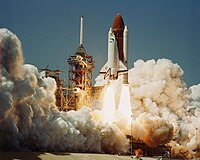
Shuttle (Launcher)
Space Shuttle Challenger (NASA Orbiter Vehicle Designation: OV-099) was NASA's second Space Shuttle orbiter to be put into service, Columbia having been the first. The shuttle was built by Rockwell International's Space Transportation Systems Division in Downey, California. Its maiden flight was on April 4, 1983, and it completed nine missions before breaking apart 73 seconds after the launch of its tenth mission, STS-51-L on January 28, 1986, resulting in the death of all seven crew members. It was the first of two shuttles (the other being Columbia) to be destroyed. The accident led to a two-and-a-half year grounding of the shuttle fleet, with missions resuming in 1988 with the launch of Space Shuttle Discovery on STS-26. Challenger itself was replaced by the Space Shuttle Endeavour, which first launched in May 1992 and was constructed from structural spares that had been ordered by NASA as part of the construction contracts for Discovery and Atlantis.

Hubble
The Hubble Space Telescope (HST) is a space telescope that was carried into orbit by a Space Shuttle in 1990 and remains in operation. A 2.4-meter (7.9 ft) aperture telescope in low Earth orbit, Hubble's four main instruments observe in the near ultraviolet, visible, and near infrared. The telescope is named after the astronomer Edwin Hubble.
Hubble's orbit outside the distortion of Earth's atmosphere allows it to take extremely high-resolution images with almost no background light. Hubble's Deep Field has recorded some of the most detailed visible-light images ever, allowing a deep view into space and time. Many Hubble observations have led to breakthroughs in astrophysics, such as accurately determining the rate of expansion of the universe.
Although not the first space telescope, Hubble is one of the largest and most versatile, and is well known as both a vital research tool and a public relations boon for astronomy. The HST was built by the United States space agency NASA, with contributions from the European Space Agency, and is operated by the Space Telescope Science Institute. The HST is one of NASA's Great Observatories, along with the Compton Gamma Ray Observatory, the Chandra X-ray Observatory, and the Spitzer Space Telescope.
Space telescopes were proposed as early as 1923. Hubble was funded in the 1970s, with a proposed launch in 1983, but the project was beset by technical delays, budget problems, and the Challenger disaster. When finally launched in 1990, Hubble's main mirror was found to have been ground incorrectly, compromising the telescope's capabilities. The optics were corrected to their intended quality by a servicing mission in 1993.
Hubble is the only telescope designed to be serviced in space by astronauts. Between 1993 and 2002, four Space Shuttle missions repaired, upgraded, and replaced systems on the telescope; a fifth mission was canceled on safety grounds following the Columbia disaster. However, after spirited public discussion, NASA administrator Mike Griffin approved one final servicing mission, completed in 2009. The telescope is now expected to function until at least 2014, and possibly 2020. Its scientific successor, the James Webb Space Telescope (JWST), is currently scheduled to be launched in 2018.

Hubble's orbit outside the distortion of Earth's atmosphere allows it to take extremely high-resolution images with almost no background light. Hubble's Deep Field has recorded some of the most detailed visible-light images ever, allowing a deep view into space and time. Many Hubble observations have led to breakthroughs in astrophysics, such as accurately determining the rate of expansion of the universe.
Although not the first space telescope, Hubble is one of the largest and most versatile, and is well known as both a vital research tool and a public relations boon for astronomy. The HST was built by the United States space agency NASA, with contributions from the European Space Agency, and is operated by the Space Telescope Science Institute. The HST is one of NASA's Great Observatories, along with the Compton Gamma Ray Observatory, the Chandra X-ray Observatory, and the Spitzer Space Telescope.
Space telescopes were proposed as early as 1923. Hubble was funded in the 1970s, with a proposed launch in 1983, but the project was beset by technical delays, budget problems, and the Challenger disaster. When finally launched in 1990, Hubble's main mirror was found to have been ground incorrectly, compromising the telescope's capabilities. The optics were corrected to their intended quality by a servicing mission in 1993.
Hubble is the only telescope designed to be serviced in space by astronauts. Between 1993 and 2002, four Space Shuttle missions repaired, upgraded, and replaced systems on the telescope; a fifth mission was canceled on safety grounds following the Columbia disaster. However, after spirited public discussion, NASA administrator Mike Griffin approved one final servicing mission, completed in 2009. The telescope is now expected to function until at least 2014, and possibly 2020. Its scientific successor, the James Webb Space Telescope (JWST), is currently scheduled to be launched in 2018.
viernes, 11 de octubre de 2013
ISS
The International Space Station ( ISS ) ( Inglés , International Space Station, or ISS ) , Also known as the International Space Station, is a research center in Earth orbit , the administration , management and development is in charge of international cooperation. The project opera en as a permanently manned space station , where astronauts rotate teams and Participating Researchers from the five space agencies : NASA, the Russian Federal Agency, the Japan Aerospace Exploration Agency, the Canadian Space Agency and Space Agency ( ESA). It is Considered one of the greatest achievements of engineering .
The Brazilian Space Agency Participates through a separate Contract with NASA . The Italian Space Agency similarly has separate contracts for various activities not done in the framework of ESA 's work on the ISS (where fully Participates Also Italy ) .
In many ways the ISS dealer to a fusion of Previously planned space stations: the Russian Mir -2 , the U.S. space station Freedom , the planned European Columbus module and the JEM (Japanese Experiment Module) . The first plans to assemble a large International station back to the 1980s . The station was planned at the time Also under the name Alpha .
The ISS is under construction since 1998 and this is the largest man-made object in Earth orbit . Complete a lap around every 91 minutes is acerca 400 km altitude ( June 2012 data) , although its actual height may vary by several kilometers due to atmospheric drag and Repeated propulsion . Skew is 51.6 ° .
The station has reached approximate dimensions of 110 m × 100 m × 30 m, with a large living area. According To plans, Should be in operation At least until 2020 .
With ISS , no human permanent Presence in space , Because there has always been At least two people on board the ISS since the first permanent crew it Entered on November 2, 2000 . The station Remains today mainly by Russian shuttle Soyuz and Progress spacecraft , and by the Space Shuttlenorteamericanos Previously , que operated until 2011 , since then the space shuttle program was Canceled U.S. Generally Because Their exorbitant costs did not correspond correspondence to cut U.S. government spending .
In its early days , the station had a capacity for a crew of three astronauts , but since the arrival of Expedition 20 , was ready to support a crew of six astronauts . Before the arrival of the German astronaut Thomas Reiter , ESA, who joins the Expedition 13 crew in July 2006 , astronauts permanent all belonged to the Russian space programs , U.S. or Canadian . Meanwhile , the ISS has been visited by 205 people from sixteen country clubs and have Also been the fate of the first space tourists.

The Brazilian Space Agency Participates through a separate Contract with NASA . The Italian Space Agency similarly has separate contracts for various activities not done in the framework of ESA 's work on the ISS (where fully Participates Also Italy ) .
In many ways the ISS dealer to a fusion of Previously planned space stations: the Russian Mir -2 , the U.S. space station Freedom , the planned European Columbus module and the JEM (Japanese Experiment Module) . The first plans to assemble a large International station back to the 1980s . The station was planned at the time Also under the name Alpha .
The ISS is under construction since 1998 and this is the largest man-made object in Earth orbit . Complete a lap around every 91 minutes is acerca 400 km altitude ( June 2012 data) , although its actual height may vary by several kilometers due to atmospheric drag and Repeated propulsion . Skew is 51.6 ° .
The station has reached approximate dimensions of 110 m × 100 m × 30 m, with a large living area. According To plans, Should be in operation At least until 2020 .
With ISS , no human permanent Presence in space , Because there has always been At least two people on board the ISS since the first permanent crew it Entered on November 2, 2000 . The station Remains today mainly by Russian shuttle Soyuz and Progress spacecraft , and by the Space Shuttlenorteamericanos Previously , que operated until 2011 , since then the space shuttle program was Canceled U.S. Generally Because Their exorbitant costs did not correspond correspondence to cut U.S. government spending .
In its early days , the station had a capacity for a crew of three astronauts , but since the arrival of Expedition 20 , was ready to support a crew of six astronauts . Before the arrival of the German astronaut Thomas Reiter , ESA, who joins the Expedition 13 crew in July 2006 , astronauts permanent all belonged to the Russian space programs , U.S. or Canadian . Meanwhile , the ISS has been visited by 205 people from sixteen country clubs and have Also been the fate of the first space tourists.

Suscribirse a:
Entradas (Atom)